The predecessor of the School of Foreign Languages and International Education can be traced back to the Foreign Language Teaching and Research Office of the university's Basic Education Department. In December 2002, it was upgraded to the Department of Foreign Languages. In July 2007, it was renamed the School of Foreign Languages. In May 2019, it merged with the former International Education School to form the current School of Foreign Languages and International Education, establishing a multi-level, international educational structure covering undergraduate education, professional master's programs, and education for international students.
The school has three departments: English, Japanese, and Translation. It currently offers three undergraduate programs: English, Japanese, and Translation, and two Master of Translation and Interpreting (MTI) professional degree programs: English Translation and Japanese Translation. Among them, the English program originated from the Foreign Trade English junior college program established in 1994, was upgraded to an undergraduate program in 2002, and was rated as a Liaoning Provincial Ordinary Higher Education Undergraduate Education Demonstration Program in 2019. The Japanese program began as the Aquatic Products Trade Japanese junior college program in 1996, was upgraded to an undergraduate program in 2000, and received approval from the Ministry of Education for the second bachelor's degree program registration in 2020. The Translation program is a newly approved undergraduate program in 2022 and officially began enrollment in September of that year. In terms of discipline construction, the school was granted the authority to confer the Master of Translation and Interpreting professional degree in 2013 and officially began enrolling graduate students in 2015. In international student education, the school obtained the qualification to educate international students in China in 1997 and started enrollment in 1999.
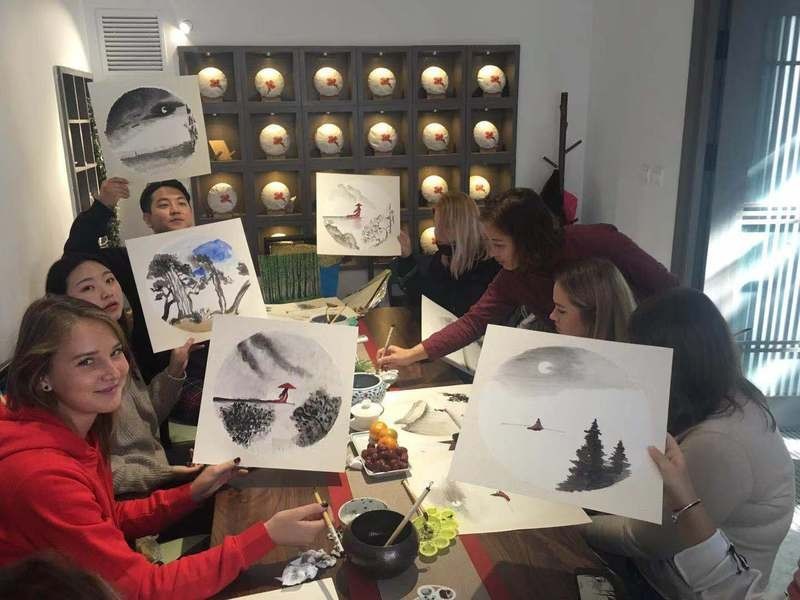
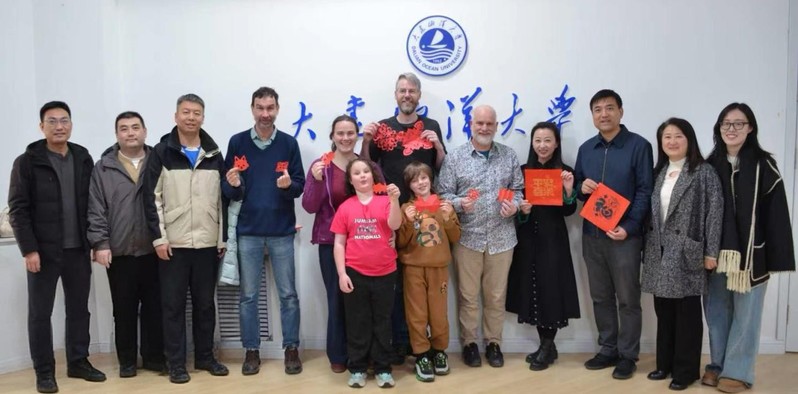
The school currently has 1,026 undergraduate students and 193 graduate students in translation. For international student education, the school adopts a refined hierarchical teaching model, offering six characteristic class types: Sino-foreign joint undergraduate classes, master's programs for international students in China, long-term and short-term Chinese language courses, international exchange student classes, HSK tutoring and training classes, and short-term business Chinese study classes. The school has cumulatively admitted over 1,000 undergraduate and master's level international students from more than 10 countries including the United States, South Korea, Australia, Russia, and Japan for further studies, with an increasingly strong international educational atmosphere.
The school currently has 48 faculty and staff members, including 40 full-time teachers and 8 administrative personnel. There are 4 professors, 15 associate professors, and 21 lecturers. Fourteen teachers hold doctoral degrees, and 28 teachers have overseas study or visiting scholar experience. The school has 1 university-level Marine-related Science and Technology Translation Team and 1 New Liberal Arts Outstanding Foreign Language Talent Cultivation Curriculum Ideology and Political Education Demonstration Team. It has 2 teachers recognized as Liaoning Provincial Undergraduate Teaching Masters, 1 Liaoning Provincial Education, Science, Culture, Health, and Sports System Employee Innovation Studio, and 1 teacher selected for the Liaoning Provincial Higher Education Teacher Training Expert Database, providing solid talent support for scientific research innovation and characteristic education. In terms of scientific research and teaching achievements, since 2019, faculty members have cumulatively published 15 translated works, 14 monographs, and 11 textbooks. They have chaired 11 provincial and ministerial-level teaching research projects and 24 university-level teaching reform projects. The school has obtained approval for 7 provincial-level first-class undergraduate courses, 11 university-level first-class courses, and 6 university-level curriculum ideology and political education demonstration courses, and has been recognized with 22 curriculum ideology and political education typical cases at various levels. Faculty have chaired 7 provincial and ministerial-level scientific research projects, forming a virtuous interactive mechanism of scientific research promoting teaching, and teaching aiding scientific research.
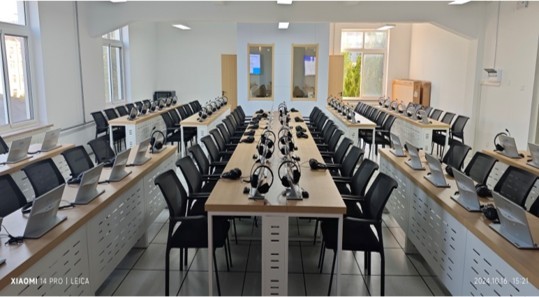
The school adheres to the educational philosophy of solid foundation, broad scope, and strong characteristics, focusing on the core goal of cultivating applied foreign language talents, and strives to improve talent cultivation quality. The school's teaching platform construction is increasingly improving. The Daheishi Campus has 4 standardized language laboratories, and the Heishijiao Campus has 1 graduate student dedicated language laboratory. In 2024, a new simultaneous interpreting smart laboratory was established, specifically serving interpretation teaching and practical training for translation master's students, laying a solid hardware foundation for cultivating practical foreign language talents. Simultaneously, the school emphasizes enhancing students' comprehensive quality and social competitiveness. The employment placement rate of college graduates continues to remain high, enjoying a good reputation in related industries and various sectors of society.
Looking to the future, the school will base itself on the university's overall development positioning, rely on the university's marine-related characteristic discipline advantages, deepen the connotation construction of international education, continuously strengthen the educational characteristics of language service + international education, focus on cultivating high-level foreign language talents that meet the needs of the national strategy of building a strong education system and regional economic and social development, and steadily advance towards the goal of building a high-level School of Foreign Languages and International Education.
(As of December 2025)